 |
|

Making the case for content
by Clive Shepherd
When you’re learning a new job, or just trying to survive day-to-day in a fast-changing environment in which it seems there’s always something new you have to understand or be able to do, then you need support. You could ask your colleague who’s the local expert on the subject at hand, but she’s probably too busy keeping up-to-date herself to react to every cry for help from people like you. Thank goodness your organisation installed a learning content management system. Now you can read all those reports, presentations and briefings that previously were scattered around the organisation. You can even take an e-learning course that’s precisely tailored to what you need to know now. What’s more, your colleague has also written up everything she knows on the subject so you don’t have to bother her with the same routine queries.
Is this a reality? Can one product really combine the benefits of e-learning and knowledge management in one integrated system? Well, maybe. In this article, Clive Shepherd examines the claims for learning content management systems and helps you to determine whether the LCMS is an acronym that you need to add to your working dictionary.
Contents
So what is an LCMS?
What an LCMS does
Taking the plunge
Case study: Cisco
Case study: Dow Chemicals
Some LCMSs
So what is an LCMS?
Just when you thought it was safe to go to a training conference again, secure in the knowledge that you could keep up with the latest techno-training-babble, along comes a new concept that sends you crashing back into the beginners’ camp. This time it’s learning content management systems, or LCMSs. You can be excused - the acronym LCMS sounds extremely similar to LMS, but is it the same thing? On the other hand, an LCMS seems to offer many of the capabilities that you associated with knowledge management systems, but are they one and the same? As will become apparent as we explore the capabilities of an LCMS, you can be forgiven for being confused, as there are many overlaps between all of these terms. But don’t let this put you off completely, because underlying the concept of an LCMS are some powerful new ways of looking at how knowledge and learning are managed in an organisation and, one way or another, these will find themselves on your agenda time and again in years to come.
Perhaps one of the best ways of understanding what an LCMS is, is by looking at what it is not. An LCMS is not a way of serving up a catalogue of ready-built and shrink-wrapped course offerings to learners. If you want to manage the provision of courses - online, instructor-led or whatever - throughout your organisation, get a learning management system, an LMS. What an LCMS allows you to do is create and assemble a library of digital content that can then be applied flexibly to suit a variety of needs - self-study e-learning courses perhaps, but also electronic performance support materials, components in virtual classroom sessions, even handouts for face-to-face events.
How about the formal definitions? Jay Cross, writing in InternetTime.com, defines an LCMS as: ‘A multi-user environment where learning developers can create, store, reuse, manage, and deliver digital learning content from a central object repository.’ Research company IDC similarly defines an LCMS as a system ‘that is used to create, store, assemble, and deliver personalised e-learning content in the form of learning objects.’
‘Aha’, you say, ‘so an LCMS is a new-fangled authoring system, one that helps you to build learning objects rather than complete courses.’ You’re on the right track, but there’s more to it than that. An LCMS draws on many of the principles of knowledge management, in that it facilitates the capture and storage of unstructured information as well as carefully-crafted training materials; the sort of information that resides on every desktop and in every employee’s head. By breaking down the artificial distinctions between information, knowledge and learning, the learner benefits - they get access to what they need from one source.

An LCMS makes it easier to meet the needs for informal, unstructured learning.
Leading LMS supplier Docent Inc., recognised this convergence when, in 2001, they acquired the LCMS vendor gForce. Docent already had tools for creating and managing formal, structured learning, but they realised that the need was equally as strong for the rapid deployment of content with a short shelf-life, that would be used on a just-in-time basis. To achieve this required a tool that would allow anyone in the organisation to rapidly create content, often using existing documents, presentations and other resources. gForce includes a number of content creation tools, including gForceAuthor, which allows subject experts to build media-rich content from standard packages such as PowerPoint and DreamWeaver. According to Docent: ‘gForce empowers individuals with tools they already know, rather than having them become instructional designers. This perfectly complements Docent's existing solution for the management and delivery of structured learning content.’
Docent is not the only LMS vendor to see* the danger that they could be perceived as peddling old technology based on ‘traditional’ learning methods (now they know how classroom trainers feel when their methods are called traditional). Rather than see a battle of paradigms - the course versus the personalised learning path - they’ve simply bought up the LCMS vendors and built content management functionality into their own offerings. Some more examples? Saba acquire Ultris and brand it Saba Content; KnowledgePlanet take on Peer3 to create KnowledgePlanet Content; Click2Learn purchase Intelliprep in order to create Aspen Learning Experience Server; Centra acquire MindLever and re-brand it Centra Knowledge Center. Got the idea?
Content vendors are also well aware of the benefits of structuring their content as reusable learning objects and supporting personalised learning paths. The MySmartForce platform allows customers to mix and match their own content, produced externally to the system, with the wide range of standard SmartForce objects to build highly customised solutions. Does this make MySmartForce an LCMS? Certainly not, but to the extent that SmartForce content forms the basis of your strategy, you will enjoy many of the same benefits.

What an LCMS does
It is impossible to pin down exactly what an LCMS should do, because there are so many different models of learning content management and so many ways in which LCMS functionality is built-into other systems such as LMSs. However, the following functionality can be regarded as characteristic:
Content creation or ‘authoring’
Critical to any LCMS is the ability for users to create new content that can be added to the content repository database in the form of re-usable learning objects. Typically, the process of authoring is highly-automated, with templates, wizards and other productivity tools, to make it possible for those with specialist knowledge, but not necessarily skills in programming, instructional design or graphic design, to build usable content efficiently. For example, TopClass Publisher, from WBT Systems, allows you to take existing training content, whether it is in Microsoft Word, Microsoft PowerPoint, HTML or plain text and simply drag and drop files into the system.
Learning content can be stored in the repository as XML, to facilitate output in a variety of media formats. And to aid searching and retrieval, it will usually be tagged with metadata, conforming to industry standards such as SCORM/IMS.
By making the authoring process so simple, it is easy to see why e-learning professionals would be sceptical about what can really be achieved. Steve Dineen is CEO and Founder of fuel, a producer of bespoke e-learning content. Steve believes that too many companies are selecting an LCMS on the basis of the authoring tools that are incorporated: ‘The tools may be appealing but they are often poor quality and only really suitable for simple, rough tasks. Although they are positioned as suitable for creating effective e-learning content, it must be remembered that they are simply basic design tools and it is the instructional designer that is the key to making effective e-learning content.’
However, not everyone believes that good results can not be achieved with easy-to-use tools. Harvi Singh is Chief Learning Technology Officer at Centra. ‘We provide different levels of tool for use in different situations. Our easiest tool, Centra Knowledge Composer for PowerPoint, allows users to work in PowerPoint to build add simple interactivity, such as menus and questions, to their presentations. At the top end we provide a proper authoring environment, Centra Knowledge Composer Pro, with a shared repository of assets, that allows reusable learning objects to be created. Although the basic structure is template-driven, users can achieve any level of sophistication that they want by importing objects such as Flash animations and HTML. It also includes a facility for developing software simulations. US developer Periscope 3 is using the tool to develop top quality e-learning material for Cisco, including interactive 3D models of routers.’
Working with a central content database facilitates large-scale content development. Joe Pelissier is Corporate Solutions Director at Click2Learn: ‘With larger e-learning projects that require 1000s of hours of material, there is a need for authoring tools that allow for collaboration across project teams. Team members will not only have different specialisations, they will often be in different places, even different organisations. Traditional authoring tools simply don’t support this way of working adequately and that’s why we built the Content Development System into our Aspen platform. It’s already helped to build large libraries of content for the National Washington Guard and NYU Online.’
Dynamic delivery
As previously discussed, an LCMS can do a lot more than serve up pre-packaged e-learning courses. When content is stored in a database in the form of reusable learning objects, it becomes possible to create personalised learning experiences based on a learner’s specific needs. This may happen in a number of ways. First of all, trainers or subject experts may define a variety of pre-set paths through a particular subject domain to suit different learners. They do this by picking those objects from the repository that they believe will be needed by each category of learner. In other cases, learning paths may be compiled intelligently by the system itself. This may sound like rocket science but the principle is quite straightforward – the system maps the learner’s capabilities, based on competency data or pre-tests, against those required for the task in hand; it then selects the learning resources which will best fill the gap. Finally, the LCMS may simply serve up the content that learners themselves have requested through search queries.
Another aspect of dynamic delivery, made possible by the fact that content is stored on a database in XML format and is therefore highly configurable, is output of content to a variety of media formats. No organisation wants to have to re-develop content for each new platform that comes along – the web, CD-ROM, PDAs and even good old paper. Ideally, the same content can be intelligently reshaped by the system – along with whatever branding and other personalisation that’s required – to suit the capabilities of the output medium. The same learning object in the repository may be published as a handout, an interactive web-based tutorial or as just-in-time information accessible on a Palm Pilot. That’s a big time saver.
Administration
An LCMS is also likely to have some administrative capability – allocating learning tasks to specific learners, managing student records, tracking learner progress and management reporting. These are features that you’d expect in any LMS, including those that incorporate LCMS functionality, but if you’re running an LCMS on a stand-alone basis, then this will need its own administrative capability.
-
Taking the plunge
An LCMS is an enterprise-wide software solution, typically installed inside the firewall. Although it will usually be integrated with an LMS, it does not necessarily have to interface with other enterprise software. So how much will an LCMS cost you? Well, according to a survey of vendors conducted in 2001 by brandon-hall.com, if you assume a five-year implementation for 8,000 learners, five servers, and 40 authors, then the average price tag was $537,000 (about $65,000 more than for an LMS). The median price was $430,000, the lowest $150,000 and the highest $1.9 million.
What do you get for this money? Well, you should get an extremely robust and versatile solution, that’s easy to install and integrates well with your existing systems. You may not be so lucky. Amongst its predictions for 2002, elearn magazine quotes Michael Feldstein, of Feldstein and Associates Consulting: ‘Purchasers of Learning Content Mangement Systems will continue to be disappointed with overpriced, over-hyped, poorly implemented, and poorly documented software that supplies none of the promised benefits.’ The reality is probably somewhere between. As with any new market, there is a rush of start-ups, full of good ideas but under-resourced to stay the course. Products are rushed out and early adopters suffer. There will be a shake-out and only the best will survive, either independently or absorbed into the more established LMS vendors. There are good products but you should proceed with care.
Take-up is so far modest. As reported in OnlineLearning Magazine’s 2001 state-of-the-industry report, 18% of organisations had purchased an LCMS as opposed to 45% who already had an LMS. Interestingly, only 16% of those currently without an LCMS said that they planned to purchase one within the next year. What does this tell us? Well, perhaps that there is low demand for an LCMS. On the other hand it could just as well be ignorance about what an LCMS is or confusion about how an LCMS differs from an LMS. Who can blame them? Come the end of 2002, it’s hard to believe that OnlineLearning Magazine will ask the same question. Rather than ‘do you have an LMS?’ or ‘do you have an LCMS?’, the pertinent issue will be ‘do you have some form of enterprise learning platform?’ and if so, ‘what features does it contain?’.
Singh: ‘Sure, the market is confused and in many ways we would be better off without the terms LMS and LCMS. Particularly in the current business climate, the goal should be to provide a learning platform that solves real business problems.’ No board is going to be convinced about a concept as nebulous as ’content’. In the end, content is not king, it’s cash.

This diagram of shows the architecture for the TopClass suite of programs from WBT Systems, illustrating how LCMS capabilities can be integrated with those of an LMS.
Case study: Cisco
Cisco is the world leader in networking hardware for the Internet, with more than 200 product families serviced by 6,000 direct sales representatives and 22,000 sales channel representatives, operating in different languages and in most of the world’s time zones. The company had been utilising 'travelling road shows' to keep the field sales force informed about new products and technologies. Since Cisco releases its hundreds of products a year in a complex cycle that transitions every six to nine months, delivering training on just a single product to the entire field via a classroom model required up to 200 classes to reach everyone worldwide. In addition, newly hired sales people were required to travel to training sites for several five-day courses each year. Relying solely on traditional classroom training was proving to be increasingly ineffective and inefficient.
Debra Gotelli, Senior Manager of Field Marketing at Cisco is responsible for field sales training for new product introductions. According to Gotelli, the requirements for a new field sales e-learning initiative were: on-demand delivery, a centralised repository for both training and reference information, an open architecture capable of leveraging existing and future technologies and - importantly - a system that Cisco Product Managers would actually use.
In late 1999, Cisco deployed a gForce Knowledge Exchange system where field sales, account managers, and system engineers receive on-demand training about new products, competitive updates and other product marketing information. Now, rather than wait for the next road show or a session at a video recording studio, scheduled about once every quarter, Cisco product managers produce web-based training at their desktops or in conference rooms equipped with gForce Studio.
The field sales force can get new training or updates when it fits into their schedule. And, because the gForce system accommodates varying bandwidths, the field is able to access the gForce portal regardless of whether they’re in the office, at home or on the road.
In less than 3 years, Cisco successfully made the transition from 100% classroom training to a web-based program (about 80% of sales and technical training at Cisco is now done online). Cisco plans to have 100% of its field sales force utilising a combination of web technologies to rapidly get the information they need to understand new Cisco products, solutions and evolving technologies. According to Gotelli, the gForce LCMS solution has increased job effectiveness by giving the sales force timely access to accurate information while cutting overall training costs by 40-to-60%.
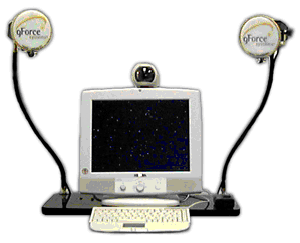
gForce Studio includes a PC, camera, lights and a backdrop, to make it easy for non-specialists to create media-rich learning content.
Case study: Dow Chemical
Powerful evidence of the potential impact of learning content management was obtained when Dow Chemical announced the result of an independent audit of their e-learning programme by one of the big 5 accounting firms. Annual savings of $34 million were made possible through reductions in the cost of course development using their LCMS, TopClass Publisher, and through reduced delivery costs compared with traditional classroom training. Dow went from spending an average $95 per student/per course on classroom training, to only $11 per student/per course using an LCMS and electronic delivery. And these savings do not include the travel expenses saved through online deployment.
Dow’s need is to provide regulatory compliance training to a workforce of more than 60,000 employees and contractors, based in 32 countries around the world, and in 6 languages. Although some of the content has been obtained off-the-shelf from publishers like NETg, the majority has had to be created from scratch - you won’t find a course in ‘fire extinguisher safety in a benzene plant’ in many course catalogues. For courses with a longer shelf-life, Dow used specialist external contractors, but most content has been created by Dow’s own trainers and subject-experts, using TopClass’ conversion and authoring tools.
The LCMS capabilities of TopClass allow Dow to not only run complete, ‘shrink-wrapped’ courses, but to mix and match learning objects to meet special needs. The system even makes it possible to personalise the learning objects to meet individual requirements. With 5000 course completions a week, it’s not so surprising that Jon Walker, HR IT Director for Dow Chemical, was sounding pleased: "The 20-1 investment return we achieved with TopClass is the highest ROI value stream of any project we have ever done in the IT area at Dow."
Some LCMSs
Jupiter Suite from Avaltus - www.avaltus.com
Centra Knowledge Center from Centra - www.centra.com
Knowledge Planet Content from Knowledge Planet - www.knowledgeplanet.com
Saba Content from Saba - www.saba.com
Knowledge Mechanics - www.knowledgemechanics.com
Aspen from Click2Learn - www.click2learn.com
TopClass from WBT Systems - www.wbtsystems.com
Docent Content Delivery System and gForce from Docent - www.docent.com
Theorix - www.theorix.com

E-learning's Greatest Hits
by Clive Shepherd
Available now from Above and Beyond
| © 2002 Fastrak Consulting Ltd |
All rights reserved |
|
|
|