 |
|

Skilling up - learning about e-learning
by Clive Shepherd
E-learning provides some exciting new possibilities for the training department, but to really take advantage of these will, in most cases, require a radical review of available competencies and an up-skilling programme aimed at the principle job roles of e-learning manager, developer and e-tutor. In this article, Clive Shepherd looks at the skills needed to make e-learning a success, at the issues involved in bringing these skills in-house, and at the opportunities currently available in the UK for training in e-learning skills.
Contents
New skills - who needs them?
What skills?
Responsibilities of the e-learning professional
Staying in or going out
Training the e-trainer
Case study: Unipart
UK courses for e-trainers
New skills - who needs them?
In many ways, as far as trainers are concerned, e-learning is just ‘more of the same’ - the same mountain of training needs, the same demanding learners, the same inadequate budget and the same impossible time constraints. What’s changed is a promise. The promise that, by making use of computers and networks to assist us in managing and delivering our training, we could meet a higher proportion of these needs, more quickly and more cost-effectively. That’s the promise.
The reality, of course, is that things are never that simple. First of all we have to create the infrastructure necessary to support e-learning, which may mean new hardware for some and possibly a learning management system. Then we have to effectively integrate e-learning into our overall learning strategy, taking best advantage of what technology has to offer without sacrificing the good things we’ve been doing so far. Next we have to source the content, which may mean buying off-the-shelf, but often means building something from scratch, a task that is quite different from putting together an instructor-led course. Lastly, we have to overcome cultural resistance, often from our own department, and then enthusiastically support the new training solutions so people actually use them. All in all, not quite business as usual. Same business, same customers, completely different business model. Skilling up for e-learning is a must-do activity for just about every training department.

What skills?
To fulfil all the demands of an e-learning project requires many different skills, certainly more than you can reasonably expect of any single person, however multi-talented. These skills can be thought of as more or less pedagogical (concerned with learning), technical (concerned with the computers and the networks) or creative (concerned with the development of engaging content). At the centre of these three sits what is perhaps the most difficult skill of all - integrating all this together through strategic and project management.
As you can see from fig 1, the e-learning skills triangle, some skills sit at the extreme corners of the triangle, and these tend to be best left to dedicated professionals. In the technical corner, we have programming and systems integration; in the creative corner, graphics and audio-visual development; and in the pedagogical corner, e-tutoring and instructional design. Why leave these skills to specialists? Because that way you get the best work, from people who live and breathe their subject and spend their time with like-minded souls. Don’t make programmers do learning design, or illustrators install your LMS. Bring in the experts when you need them, for as long as you need them.
Fig 1: The e-learning skills triangle.
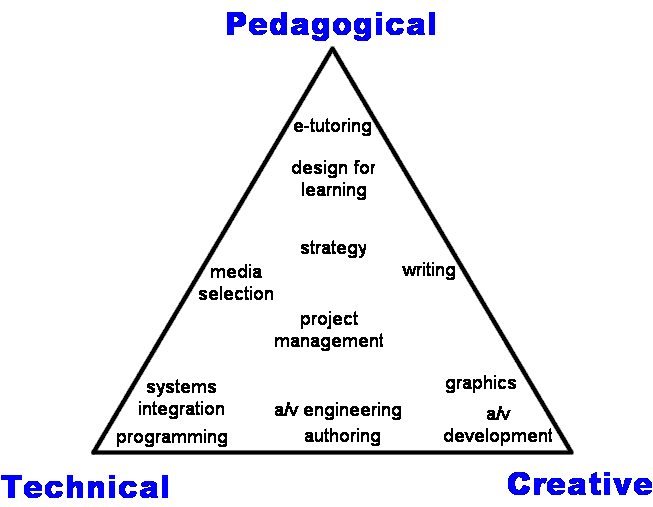
An e-learning project brings together a mix of pedagogical, technical and creative skills. At the three extremes are skills which are probably best left to dedicated professionals. Towards the centre are the more generalist and management skills.
Where does that leave you, the trainer who wants to take an active role in e-learning, who might even see their career as a dedicated e-learning professional? Well, first of all, chances are, that if you’ve received formal education or training as a teacher or trainer, then you’re well equipped to operate in the pedagogical corner, as a designer of e-learning content or as an e-tutor. You will still need some e-skills, to help you apply your past experience to the new technology, but you’ll be well on the way.
If you’re more technical, you could play a more active role with the technology, helping to select the most appropriate media and interfacing with the techies. If you have luvvie tendencies, there are opportunities to express your writing skills or to work on the creation of the visual material (probably not illustration or animation, but the simpler stuff). You could also turn your hand to authoring, which, rather like desk-top publishing or working with presentation software, brings together the technical and the creative.
Lastly, if you feel you have some understanding of all the disciplines, and can combine all these elements in the pursuit of the e-learning vision, then there’s scope for you as a creator of the e-learning strategy or as a project manager. So, something for everyone.
- Responsibilities of the e-learning professional
In the course of an e-learning project, the myriad of job roles can be associated with three main areas of responsibility: the e-learning manager, responsible for establishing the e-learning strategy and managing individual projects; the developer, for designing e-learning programmes and producing the content; and the e-tutor, responsible for supporting e-learners when the learning is in progress. The following table shows how roles can be allocated to each of these, although in practice there’s a fair degree of overlap.
-
| Manager |
Developer |
Tutor |
Strategist
Learning analyst
Project manager
Marketeer |
Instructional designer
Writer
Graphic designer
Programmer
Author
Audio-visual specialist
Tester |
Administrator
Coach
Subject-matter expert
Assessor |
-
There are few rules about the job descriptions in e-learning, so all sorts of combinations occur in practice. The same person may act as project manager, instructional designer, writer and author; another may fill all the roles of the e-tutor; yet another specialise in graphic design alone. As we’ve already discussed, there are arguments for making a distinction between specialists and generalists, but some organisations prefer to multi-skill across the board.
Marilyn Clarke is a Multimedia Learning Author for the insurers Clerical Medical and is part of a team of four serving the company’s 2-3000 employees: ‘As a small team, we all have to be competent in each of the tasks involved in e-learning development. We may have preferences for certain tasks over others, but, with training, we’re able to undertake them all.’ The same applies at law firm Herbert Smith, where a small team of three, including a manager, provides specialised e-learning content for an organisation of 1600 employees. Gail Nugent is an e-Learning Consultant: ‘We carry out all aspects of the project in-house from the initial marketing, to liaising with subject experts, design, graphics and authoring. The only technical help we’ve needed is in publishing to the intranet!’
The bigger the team, the more likely that specialisation will occur. At e-peopleserve, a team of about 40 people has been developing technology-based training materials since the early 80s. Eric Farnworth is e-Learning Design Manager: ‘We have enough of a team to specialise, so we separate out project management from design. We employ graphic designers and authors. We even have a QA expert responsible for testing. It’s our experience that specialists work quicker than generalists and now we can recruit them directly from outside, where 20 years ago we had to grow all our own skills.’
Staying in or going out
All three of the main e-learning responsibilities - manager, develop and e-tutor - can, if required, be contracted out to consultants, producers and freelancers, although some expertise must remain to determine the strategy and manage the outsourcing relationship. So why would an organisation choose to maintain e-learning skills in-house? Clarke: ‘We have a lot in our favour. We have years of experience working within the company, which means we know our stuff and have the right contacts. We are more flexible than external contractors and can adapt easily to the company’s changing priorities. What’s more, we remain accountable even after the product is delivered, where an outside firm can just vanish.’
Of course, there’s always money. Nugent: ‘We don’t cross-charge our costs, so internal departments would find external contractors much more expensive by comparison. Not that there’s the demand - our products are well-received and we’re even raising revenue for the firm by re-selling to other companies.’
At e-peopleserve, the same rigorous project management techniques are employed that you would find in any reputable external production company. Farnworth: ‘We employ a sophisticated technique for estimating the work involved in any project. Once the project is under way, we monitor all the effort being put in to ensure that we’re sticking to budget.’ These methods will be tested as e-peopleserve expands its customer base.
Training the e-trainer
According to a survey conducted in 2001 by the European Training Village (ETV) of 446 trainers and vocational teachers across the EC, a surprisingly high amount of training for e-trainers is already taking place. 60% have undertaken some form of informal self-development. 30.5% have had formal classroom-based training, 18.6% formal web based training programmes and 16.4% some form of hybrid. Just over 17% of the training that respondents received was in ICT skills, 24.2% in the 'exploration of new pedagogical approaches in e-learning' and 18.9% in project management skills. Surprisingly, only 2.1% were undertaking skills development for e-tutoring. Of greatest concern are the quality ratings that the training received - 21% rated them poor, 45% only fair, 26% good, 7% very good and only 1% excellent. According to the ETV, ‘the overall low ratings may be attributable to the fact that trainer training programmes in this domain are very immature and often somewhat experimental.’
Certainly, there has been a lively response within the UK to the call for better quality training for e-trainers. The Chartered Institute of Personnel and Development (CIPD) has launched a range of new programmes, including its flagship, the Certificate in Online Learning (CoL). Karen Ver is Business Manager, e-Learning: ‘The CoL programme has been launched as part of the Institute’s new strategy for e-business and recognises the new opportunities for trainers afforded by e-learning. The course provides a thorough grounding, from the basics of the Internet upwards. Students obtain a familiarity with the online environment, opportunities to collaborate online and the chance to create of a framework for a real e-learning course.’ Clearly the course is meeting a demand, because 126 have already booked on the 18-20 week online course. Graduates of the course can then progress to a number of more advanced courses providing specialist skills.
Perhaps strangely, some trainers prefer to learn about e-learning in the classroom. Rodney Thomas is CEO of Academy Internet: ‘These are early stages. Many trainers want to learn about this new medium in the comfort of familiar surroundings. At present all of our courses for trainers are classroom-based, although we will shift to online delivery as demand increases. We’ve also found that more and more of our customers want their own customised solution, so at present all of our courses are offered on an in-company basis.’
The Institute of IT Training has been running a programme of classroom and online courses for project managers, developers and e-tutors for some two years now, based on its own widely-endorsed competency framework. As of 2002, the offering has been considerably enhanced, under the umbrella heading of Certified e-Learning Professional (CeLP). Explained Nick Mitchell, Chief Executive of the IITT: ‘More than 2,000 individuals from industry and academia have enrolled on our Online Tutor and Online Trainer courses over the last two years. This new certification programme builds on the experience we’ve gained and offers a much wider curriculum to those wishing to make a career in e-Learning. Research continues to show that a global shortage of skills is holding back companies from implementing and benefiting from e-Learning - this is not just a UK need, it’s world-wide.’
Whether you see yourself as an e-learning manager, a developer or an e-tutor; whether you like to receive your training in the classroom or online, it seems that now there are no excuses. The UK is providing quality training for the e-learning professional and that’s what’s needed to ensure that we take our place as a leading e-learning provider and that e-learning fulfils its potential in transforming education and training in the UK.
Case study: Unipart

Barry Conway
Unipart Advanced Learning Systems (UALS) had its origins as a small team looking at exploiting the web for sharing knowledge of manufacturing procedures. When the team spotted the opportunity to create a series of small learning objects that would save trainers from travelling around the UK to deliver the same sessions over and over again - and these were received extremely well - the in-house e-learning department was born.
Barry Conway is Head of e-Learning for UALS: ‘We realised straight away that we wouldn’t be able to buy what we wanted off-the-shelf - if we wanted these learning objects, we’d have to create them ourselves. We also knew how important it was, at this early stage, to provide a sound business justification for what we were doing – something we have maintained ever since.’
‘We charge our internal customers for what we do and that focuses the mind. If there was no charge, we’d have to deal with a long queue. Because we charge, it’s important that we check ourselves from time-to-time against outside rates, so we’re providing a competitive solution. We believe that, because of our subject expertise, we can deliver more than our outside competitors. We’re also much more pragmatic - there’s no prima donnas here.’
‘When we started, it was important that we could all turn our hand to every aspect of the task. As the team grew - and there’s now around 20 of us - we began to specialise. Apart from project manager/designers, we have separate graphics and programming personnel, some of which we bring in on contract. We also like to bring members of the company in on secondment, for cross-training.’
‘UALS has a promising future, not least because we are business-driven and not the personal crusade of a single product champion. We are confident enough that we are doing it right to offer our services widely to other companies, and that ensures that we’re always matching ourselves up to the competition.’ Clearly everyone stands to benefit from in-house development at Unipart.
|
|
|
