|
|

The end of the course as we know it
by Clive Shepherd
The days may well be numbered for the course as the essential ‘unit of learning’. The typical course is a shrink-wrapped offering where every learner receives the same training, regardless of the job that they do or the skills they already possess. As Clive Shepherd demonstrates is this article, what’s needed is a more targeted approach in which training is precisely tailored to job and individual needs. To make this possible we require a new paradigm for training delivery, one that is based on the intelligent deployment of learning objects.
Contents
Halcyon days
Harsh realities
Enter the cavalry
Putting objects to work
Just for me
Objects pay
The view from the field
The ideal course is C shaped
Halcyon days
In the good old days (I know, here he goes again), running a training department was simple. Each summer you sat down with your printers to put together the next year’s glossy colour catalogue of classroom courses, or personal development opportunities as they were now called. Next year’s catalogue bore a striking resemblance to this year’s, but then there was no point in upsetting the apple cart - after all the happy sheets were still just about managing to keep you, and more importantly your boss, happy. In rare moments of self-doubt, you reminded yourself how you held the moral high ground because, at some stage in the distant past, each of the courses in the catalogue had been created to meet an identified need. Whether those needs still existed (or ever did) is debatable, but then no-one had ever complained. At least not in earshot. Over a period of time, just about everybody who mattered went through every course in the catalogue, perhaps because those were the only ones you had, but also because you held them in fabulously desirable locations.
Before your time obviously. I know, it’s barely credible that such things ever happened and it is surely impossible that practices such as these could continue in these enlightened times. Well, moving on ...

Harsh realities
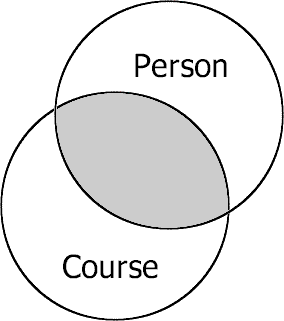
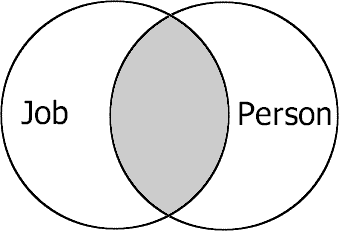
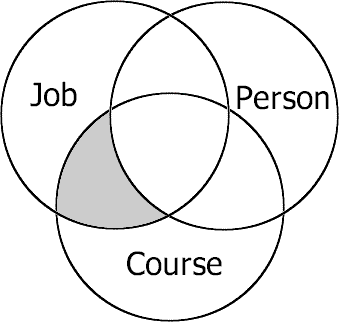
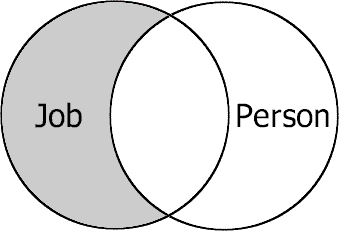
In practice, common sense tells us that the ideal course is ‘C’ shaped (if in doubt, see the panel). It provides the skill and knowledge required for the learner to do their job competently and no more. It doesn’t cover skills that the learner already has. It doesn’t try and teach topics that are un-related to the learner’s job. It fits like a glove. In the real world the idea course is so rare, it should be proclaimed an endangered species.
There are two significant barriers to offering courses that are ‘C’ shaped. The first difficulty comes with learners themselves. They’re all different. Not only do they come with their own existing skillset, which may or may not coincide with the requirements of the job, they also have preferences for certain media and methods, and personal circumstances which dictate when they like to learn and where. In the past we ignored these differences and we sent them all on the same courses regardless. We wasted a lot of time and money, but it was convenient for us and we couldn’t think of anything better.
The second problem comes with the jobs. They won’t stay still. By the time you’ve prepared the training programme, they no longer exist or they’ve changed beyond recognition. New products, new directions, new systems, new responsibilities - all designed to make your job more difficult. You could just plough on regardless and offer the same old courses, but you’d be consigning the training department to death by neglect.
-
Enter the cavalry
Two developments give us some hope that we can meet the challenges of constant change and individual differences - one is new technology, the other a new way of thinking. The technology has been around a while now, in the form of personal computers and networks, and has made it easier for learners to access courses on a self-study basis or, with other learners, in virtual classrooms. Convenient, cheaper, more efficient, but still canned courses - the same experience for every learner regardless of their existing skills and the jobs they undertake.
The new thinking is more significant and is not necessarily confined to technology-assisted learning. It is based on a new paradigm, in which training is no longer offered as ready-made, shrink-wrapped products, but is instead built to order from a large variety of basic ingredients. The offering is a personalised learning path. The ingredients are learning objects.
Let’s just clarify what we mean by learning objects. A learning object is a component of a learning programme. It could take a number of forms: information material; practical exercises (questions, games, simulations, assessments, etc.); descriptions of, or instructions for collaborative activities (which could include non-digital events); and composites, e.g. interactive tutorials. In case that’s not clear, that means we’re talking about more than your typical, interactive self-study e-learning materials. Learning objects provide a gateway to any learning activity you can conceive, online or not and to all sorts of documents that could conceivably support learning and performance.
What makes a learning object different from any old web page, Word document or other digital resource, is that it is provided in the context of a learning objective and a process or method. Both the objective and the method can come from a number of sources: from the author of the object, and explicitly stated as part of the object itself; from a mediator (administrator, teacher, trainer, coach, supervisor, parent, etc.) and referenced separately from the actual object; or from learners themselves, whether or nor explicitly stated. This means that learning objects can work with any pedagogy, from the most authoritarian to the most liberal.
Putting objects to work
 Learning objects in themselves are just components, rather like books in a library. They are aggregated into personalised learning paths (you can call these courses if you like) in a number of ways. First of all, a mediator, such as a trainer, could select the objects that they feel best meet the needs of a particular target audience, such as a department in their organisation. Peter McClintock is e-Learning Director at Global Knowledge. He describes how these options work in practice. ‘With the aid of a learning content management system (LCMS), it’s the simplest thing for a trainer to select learning objects from a repository to create a customised offering. This would have been completely impractical in the past.’ Learning objects in themselves are just components, rather like books in a library. They are aggregated into personalised learning paths (you can call these courses if you like) in a number of ways. First of all, a mediator, such as a trainer, could select the objects that they feel best meet the needs of a particular target audience, such as a department in their organisation. Peter McClintock is e-Learning Director at Global Knowledge. He describes how these options work in practice. ‘With the aid of a learning content management system (LCMS), it’s the simplest thing for a trainer to select learning objects from a repository to create a customised offering. This would have been completely impractical in the past.’
With the aid of an LCMS, it’s also possible for the learner to determine their own learning path, working with a search engine or a series of menus. McClintock: ‘When all of the content is online, rather than on a CD-ROM, the learner can dip into any of the material in the library according to their own needs. In this situation, the concept of ‘course completion’ becomes irrelevant. To make the learner’s job easier, it’s vital that each learning object is properly described in terms of what it is designed to achieve and what it covers.’
Personalisation is also possible without an LCMS. McClintock describes: ‘All Global Knowledge courses have pre-assessment modules. Depending on how the learner performs in the pre-assessment, they are prescribed a personal path through the material, making sure they only cover what they really need. It’s also possible to relate the pre-assessment to organisational needs, because trainers can determine what an acceptable pass mark may be for any given topic. If, for example, TCP/IP is a vital area for a particular job function, then the required score could be as high as 100%, whereas for, say, XML, the issue may be of less importance and a score of 60% may be adequate.’
 The object-orientated approach may be easiest to implement in the digital environment, but we know that what many learners really want is blended solutions, combining the best of online and face-to-face delivery. Thomson Learning has responded to this fact by bringing together three disparate divisions to provide one coherent offering to the market: NETg brings e-learning, Wave stand-up training and mentoring, Course Technology books and materials. Jon Buttress is Director of Product Management at NETg: ‘Our aim is to make it possible for clients to seamlessly mix and match classroom, e-learning and mentoring approaches. Everything we create will be produced at an object level, even if it is eventually packaged up as a classroom event or a book. Our customers will be able to select the right combination for their needs, perhaps even using different methods in different countries.’ The object-orientated approach may be easiest to implement in the digital environment, but we know that what many learners really want is blended solutions, combining the best of online and face-to-face delivery. Thomson Learning has responded to this fact by bringing together three disparate divisions to provide one coherent offering to the market: NETg brings e-learning, Wave stand-up training and mentoring, Course Technology books and materials. Jon Buttress is Director of Product Management at NETg: ‘Our aim is to make it possible for clients to seamlessly mix and match classroom, e-learning and mentoring approaches. Everything we create will be produced at an object level, even if it is eventually packaged up as a classroom event or a book. Our customers will be able to select the right combination for their needs, perhaps even using different methods in different countries.’
Just for me
An object-orientated approach can help in making sure that individual learners get the right training to meet their job requirements, but can it help in delivering the learning in the right way, the way that suits their personal preferences? Buttress: ‘We’ve conducted some research this year to find out how it is that people learn best. What we found is that, whilst many learners prefer a bottom-up approach, learning step-by-step before attempting any practical assignments, others prefer to go top-down. These learners were presented with a series of real-world tasks that they could get stuck into straight away. When they needed help, they could turn to a variety of forms of support, such as books, mentors, e-learning modules. For the right learners this approach proved highly successful and, although it took a little longer, the learners were actually faster and more accurate than those receiving traditional training.’
 Logilent is another training provider that appreciates how important it is to recognise individual differences. Graham Shenton is Managing Director for EMEA: ‘We realised that we needed a multi-sensory approach to cater for different learning styles. We provide students on our accreditation courses with a wide variety of ways of approaching the subject - texts, CD-ROMs including video and other media, lab exercises that allow learners to remotely work with the target hardware and software, learning communities and mentoring. There is a large amount of redundancy in that the same material is covered in many different ways, but we know that our learners differ widely in the approaches that they prefer. As a result our completion rates are much higher than average and 92% of those who take their exams pass.’ Logilent is another training provider that appreciates how important it is to recognise individual differences. Graham Shenton is Managing Director for EMEA: ‘We realised that we needed a multi-sensory approach to cater for different learning styles. We provide students on our accreditation courses with a wide variety of ways of approaching the subject - texts, CD-ROMs including video and other media, lab exercises that allow learners to remotely work with the target hardware and software, learning communities and mentoring. There is a large amount of redundancy in that the same material is covered in many different ways, but we know that our learners differ widely in the approaches that they prefer. As a result our completion rates are much higher than average and 92% of those who take their exams pass.’
Objects pay
The proof of the pudding is in the eating, so do learning objects pay off in practice? Well, Cisco are pioneers of learning objects and they’re certainly reaping the results. In the past it could take up to nine months to develop a course that is now up and running in 12 weeks. In one year more than 20,000 learning objects have been created. Writing in Learning Circuits, Peg Maddocks, a director in Cisco Systems’s Internet Learning Solutions Group, claims that: ‘because reusable learning objects assist in making prescriptive learning a reality, there has been a collective attitude change among employees, who now embrace e-learning as a critical career development tool. One of our favourite new mantras is "just-in-time and just-for-me". Cisco is now able to offer an assessment that prescribes the objects people need to achieve the desired performance. We don’t evaluate the number of click throughs or hours logged on, but whether learners fare well on post-learning assessments. From a learning perspective, what Cisco cares about is performance.’
So, from the learner’s perspective, it doesn’t matter whether the learning they receive is bundled as ‘courses’ or ‘objects’. What matters to them is that they get the training they need to meet the requirements of their job, without a lot of wasted effort and in a way that suits them. Both learners and their employers would be justified in asking whether that is too much to ask for.
Is the course dead? The view from the field
What do trainers feel about the possibilities for a more tailored approach to training? Here’s a selection of views from the field:
A course should fit the learner’s needs, the skills required and their learning style. This is an ideal view that I wish was more acceptable and I hope the technology and innovative methods become available to allow for this to develop. I would really value a course that recognised the exact skills I wanted, delivered them for my learning style and linked me with fellow learners for those areas where there are similarities with other courses.
Cassandra O'Callaghan, Resource Information Service
I see evidence every day of peoples’ individual learning capacities. Everyone learns differently, at different speeds and using different styles. One example of new learning is the European Computer Driving Licence - much like the normal driving licence, it doesn't matter how you learn as long as the criteria are met. The learning method is left to the individual.
Christine Easton, The People’s College, Nottingham
My own recent experiences with training lead me to agree with the idea of "just in time" type training customised for a specific user. Desk visits with one of my major clients have proved to be very popular as they are tailored (after a short chat on the phone with the other person) to that person’s needs. This saves a lot of time and lost productivity in attending a 1-2 day software course that is only 25% useful to the end user.
Dave Stokes, The Fifth Business
What about the interaction between different levels which enables people to understand a subject more broadly and at a deeper level? Some courses and training needs will lend themselves to being tailor-made but some will not.
Debbie Wallis, Academy Internet
It sounds as though it will always be quite expensive, not just in terms of having all the options available to suit everybody but also in discovering what those "right" options are. My concerns are that the technology wouldn't be up to it or the analysis wouldn't be detailed enough. Sounds like another one for the high end of the market.
Donna Wheeler, Happy Computers
I reckon delegates would welcome the idea of "training just for me" but that organisations don't necessarily have the funding, resources or technology available to make this a reality.
Lisa Johnson, Barnados
Even with the introduction of learning objects, individually tailored courses generally cost more to produce and therefore may not have the payback that the "canned" catalogue courses do by appealing to a wider audience. So it is cost that, in my opinion, will be the real driver.
Yvonne Blakeway, e-peopleserve
I think we have generally moved in this direction anyway. Learners now have access to several different types of learning materials which cover the same subject matter, and can choose to study using their own preferred method.
Charles Murray, University of Abertay, Dundee
This article confirms that great minds think alike. A clip from my blog last month: "The course is not the appropriate shell for most learning experiences. We all know the story: the fifty-minute hour and the two-day workshop were created for the convenience of the institution, not the learner. The course is a triumph of standardization and it is so ingrained in our thinking that we still buy and sell seat-time rather than performance improvement. It's the industrial model, which puts a higher value on efficiency than on effectiveness. You can have learning any color you want as long as it's black."
Jay Cross, InternetTime, www.internettime.com
|
|
|